Why readers stop trusting AI-polished writing
A great topic can still lose you after three lines. I think AI belongs in the process as a secretary, but its drafts run long, never slip, and flatten everyone's English. What the research says about each, and two skills that may or may not deserve to exist.
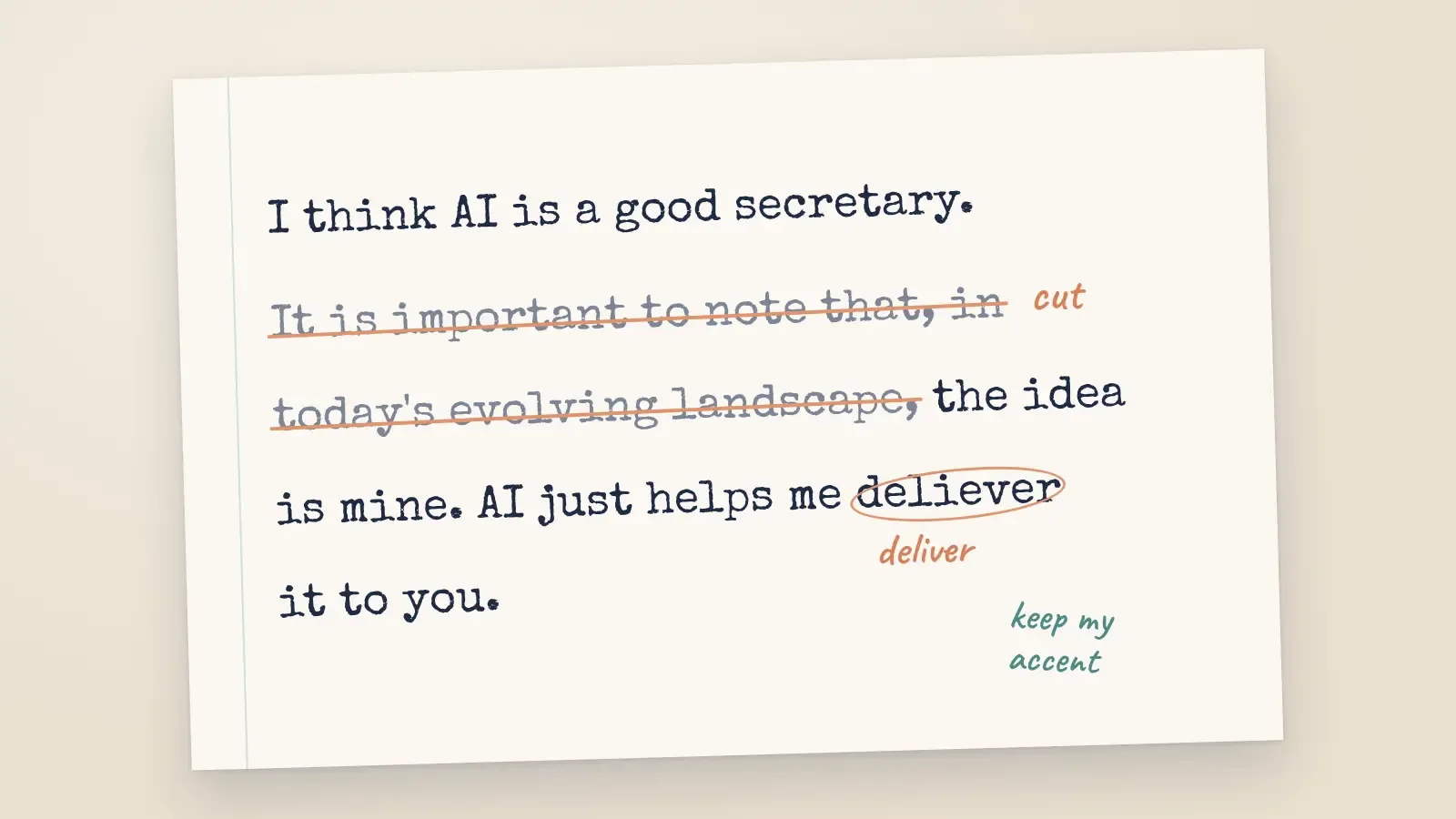
You open a post on a topic you care about. Three lines in, something feels off. The rhythm is too even. Every paragraph closes with a neat little lesson. You keep scrolling, but you no longer trust the author.
The topic did not get worse. Your trust in the text did.
Bynder ran a test with 2,000 people in the US and UK in 2024. Readers compared two short articles, one written by ChatGPT and one by a person. Only half could tell which one the machine wrote. Without labels, 56% preferred the AI version. Yet 52% said they felt less engaged once they learned a text was AI-generated. So readers are not great detectors. What changes their attitude is the belief that nobody wrote the text.
That was 2024, and the gap has only become clearer. In a July 2026 DoubleVerify and YouGov survey of 2,000 UK consumers, 92% said AI-generated content undermines trust online. Only 41% felt confident they could spot it.
AI is the secretary, not the author
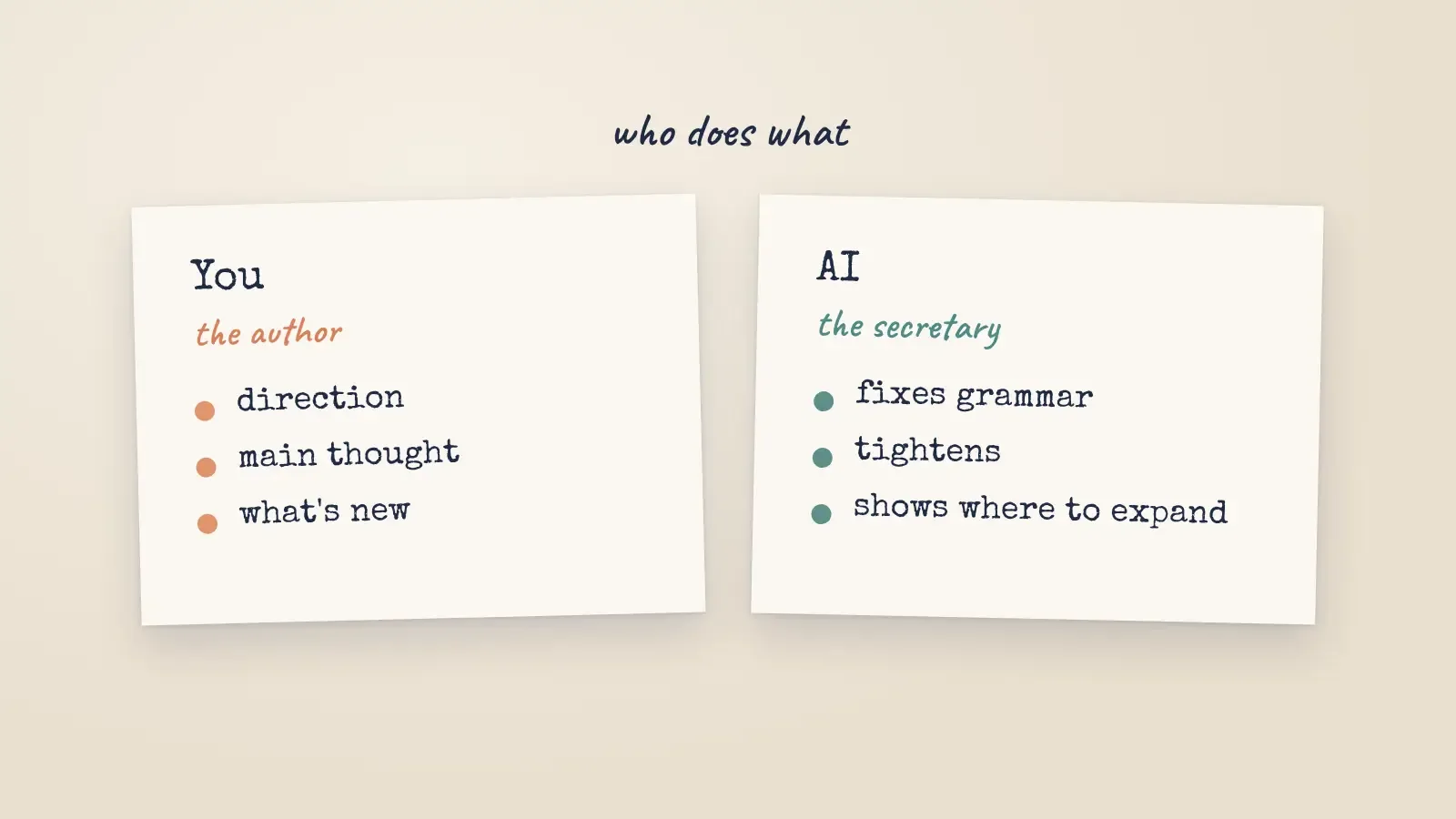
I think of AI as a good secretary. It fixes my grammar, tightens a paragraph, and points out where an idea needs more room. It does not decide what the post is about. The direction, the main thought, and anything new in it have to come from me. When that order flips, I think readers feel it, even if they cannot point to it.
Wikipedia editors have collected what they notice into a guide called Signs of AI writing, maintained by WikiProject AI Cleanup. It lists inflated claims about significance, vague attributions, forced groups of three, and the overused em dash. The guide also warns that it is not a ban on words or punctuation, and that the signs matter in combination.
Some of these signs are already aging. The em dash, the most famous one, is disappearing from new models. In a Graphite study reported by VentureBeat in September 2026, Claude Opus 5.5 used about 99% fewer em dashes than Opus 5, and far fewer than the human articles in the same test. Arena measured a 95% drop on its own prompts. A text without em dashes proves nothing anymore. Graphite still found 2,548 other words and phrases that Opus 5.5 uses at least twice as often as human writers.
Someone turned that guide into an agent skill. Humanizer is an open-source skill for Claude Code, Codex, and similar agents that rewrites text to remove those patterns while keeping the meaning. It is a good start and it cuts some filler. Still, I see three problems it does not fully solve.
Problem one: it is too long
Real people rarely write texts this long. A person with something to say usually says it and stops, while a model keeps going.
One study suggests why length gets rewarded. In 2023, Saito and colleagues found that GPT-4, used as a judge of answers, favored longer responses more strongly than human judges did. When machines grade machines, length can look like quality.
The habit has not gone away with newer models. In the same Arena comparison, average answers grew from 453 words with Opus 5 to 481 with Opus 5.5, even as sentences got shorter.
The best antidote I know is older than AI drafts. «Пиши, сокращай» ("Write, Shorten") by Maxim Ilyakhov and Lyudmila Sarycheva is a Russian-language book on clear business writing. Its first edition came out in 2016 and sold 500,000 copies. The 2025 edition was reworked and adds a chapter on the editor's career and neural networks. Its core idea fits on a sticky note: find the words that carry no meaning and remove them. That works on an AI draft as well as on a human one. The book's method is already available as an agent skill: sokrati is an open-source Claude skill with versions in seven languages, and the English one is called shorten.
Problem two: it has no mistakes
AI almost always follows the rules. A polished AI draft has every comma in place and every word spelled right. People are not like that.
When I see a typo, I know the text was not written by AI. Yes, a mistake costs a writer some credibility. Today I think that cost is worth paying. A human with a few errors is worth more to readers than a flawless text with no person behind it. What matters is the signal the reader picks up without noticing it: a human wrote this.
Research narrows this idea. In 2024, Bluvstein, Zhao, Barasch, and Schroeder ran seven studies with 3,399 participants on customer-service chats. Agents who made a typo and then corrected it were seen as more human and more helpful than agents who made no typos, and more than agents who left the typo in place. In this study, the correction did the humanizing. A typo left in place did not help.
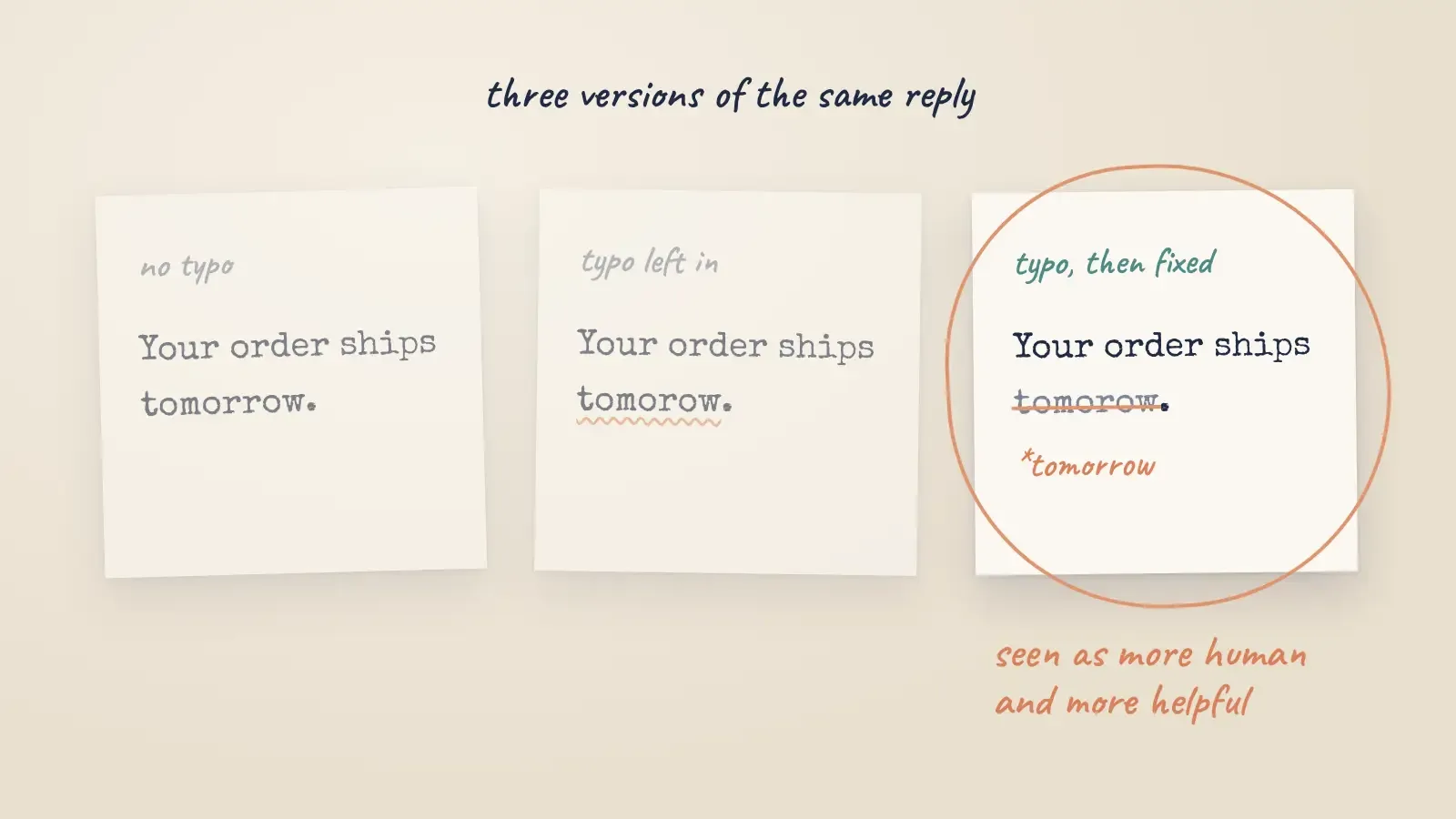
So here is an idea for a skill. Call it a mistakaizer: it would add a few human imperfections to an AI-polished text. A typo fixed in the next line, or a paragraph that runs a little long. The goal is that the reader feels, without thinking about it, that a person is on the other side.
I am not sure it should exist. If readers trust typos because machines do not make them, planting typos on purpose spends that trust. On the other hand, if your own draft had those quirks before the AI smoothed them away, restoring them is closer to repair than to forgery.
Problem three: it is the wrong English
Many people writing in English are not native speakers, and many native speakers are not American. Their phrasing and their examples differ, and AI tends to sand those differences away.
- Detectors flag non-native writers. A 2023 Stanford study in Patterns tested seven GPT detectors. More than half of 91 TOEFL essays by non-native speakers were flagged as AI-generated, while over 90% of essays by US eighth-graders were correctly classified as human. Simpler vocabulary triggered the false positives. Those were 2023 detectors. Originality.ai, one of the tools tested, disputes the study and reports a 5% false positive rate on non-native essays in its own 2025 test. Even that means one non-native essay in twenty gets flagged. This is a different problem from style, but it lands on the same people.
- AI suggestions pull writing toward American style. In a Cornell study presented at CHI 2025, 118 participants from the US and India wrote about their culture. The assistant suggested pizza for favorite foods and Christmas for favorite holidays. When an Indian participant started typing the name of Shah Rukh Khan, it offered Shaquille O'Neal.
- Polishing erases cultural markers. A 2026 study of Indian, Singaporean, and Nigerian English analyzed 22,350 model outputs from tasks like email polishing. Models removed about 10% of cultural markers overall, and politeness conventions were hit hardest. In this preprint, explicit instructions to preserve them cut the erasure by about 29%.
The Cornell team quoted how Indian participants described Diwali without and with the assistant:
| Without AI | With AI |
|---|---|
| "worship goddess Laxmi" | "eat traditional Indian breakfast items" |
| "pop crackers and eat sweets" | "a time filled with happiness and warmth" |
Usage is uneven, too. Kobak and colleagues studied over 15 million PubMed abstracts and estimated that at least 13.5% of 2024 abstracts were processed with LLMs. The lower bound was around 5% for the UK and Australia and around 20% for China, South Korea, and Taiwan. The authors suggest non-native speakers may adopt LLM help more readily, though native speakers may also be better at removing obvious AI wording.
One theory said ChatGPT loves the word "delve" because many of the people rating its answers spoke Nigerian English. Juzek and Ward checked and found no evidence that "delve" and similar words are especially common in any particular variety of English. Where the habit comes from is still open.
So the second idea: a cultulizer. A skill that keeps your English yours. It would preserve the phrasing and references of the writer's own culture instead of converting everything into the same neutral American voice. The 29% result suggests that asking a model to preserve these markers already helps.
Should these tools exist?
A humanizer, a mistakaizer, and a cultulizer can make AI-assisted writing more honest to its author. They can also make AI writing better at hiding.
A 2025 stylometry study from University College Cork found that AI-generated stories cluster tightly together, while human writing is "more varied and idiosyncratic." Maybe the answer is to leave the person in: your opinion, your accent, your occasional typo.
Disclosure does not settle it either. A small 2026 experiment with 34 news readers found that detailed AI-use disclosures reduced trust, while a one-line disclosure performed about the same as none.
I have not decided whether to build the mistakaizer and the cultulizer. Should they exist? Would you use them, or would they cross a line? Tell us on X.